Police Ranks in India: Complete Hierarchy Explained (2026)
Police Rank in India: Police Rank in India is categorized hierarchically based on Police Posts in the department. The state policing system is dependent on the Police Rank in India and it varies from state to state. Indian Police Service(IPS) is the last direct entry in Police rank in India. In this article, we have discussed in detail about the Police Rank In India with the badges.
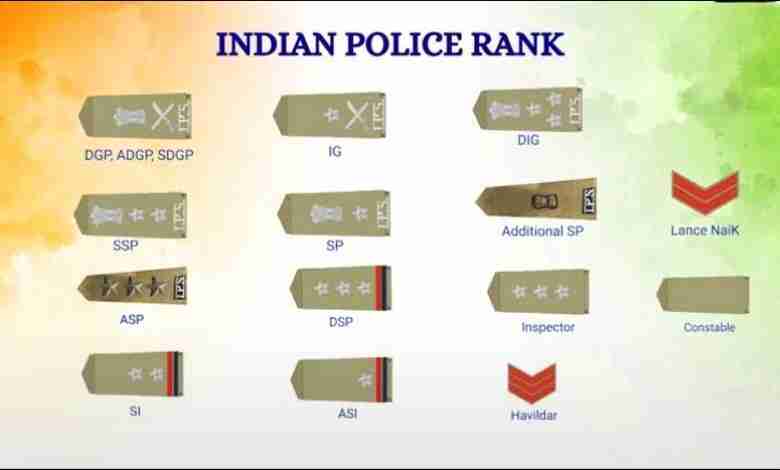
Police Ranks in India: Officers of various ranks constitute the Indian Police Department. Examining their badges reveals the differences between them. Candidates interested in joining the Indian police force should be aware of the differences between these grades and badges. We’re going to tell you about all of the Indian police ranks or simply the list of police officers ranks in India from this article.
Table of Contents
List of Police Ranks in India and their Insignia
Let us look at the organizational structure of the Indian Police Department and the list of police officers ranks in India here.
Each of India’s 28 states has its own police force. Each state government is in charge of overseeing it. The state’s Chief of Police is known as the Director-General of Police (DGP).The hierarchical structure and rank of the police organization are as follows:
Below is the complete list of police ranks in India according to the Maharashtra State Police:
1. Director General of Police (DGP)

The DGP is the highest-ranking police officer in a state. They head the entire police force and are responsible for major policymaking, overall supervision, and coordination. Every state usually has one DGP who reports directly to the state government, especially the Home Department.
The Andhra Pradesh Police website mentions: “The Director-General of Police is the head of the Police Department of the State. His main role is Law enforcement and thereby, to promote the dynamic Rule of Law. The functioning and administration of the police throughout the State are vested in him. He advises the Government on all police matters, both administrative and operational. He is responsible to the Government for the internal management, economy, equipment, training, discipline and efficient discharge of duties by all members of the force. He is ultimately responsible for making the Police organization fully efficient at all levels for preventing and detecting crime, maintenance of public order, law and order, safety and security and preservation of peace.
He has to keep the Government informed of the state of crime and all political, communal, subversive and terrorist movements throughout the State and to advise the Government as to the manner of dealing with them.”
2. Additional Director General of Police (ADGP)

An ADGP assists the DGP in managing state-level operations. They supervise important zones or special branches like law and order, crime, training, or administration. They ensure that the DGP’s policies are implemented smoothly.
The Andhra Pradesh Police website mentions: “The Addl. Director General of Police (L & O) is the staff officer of the DGP to assist him in supervision of the police of all the districts in the state in the matters of prevention of breach of peace, maintenance of public order, law and order, planning and implementation of operations and in dealing with all situations including terrorist and subversive activities, communal, caste, or regional or other widespread agitations subject to the control of DGP.”
3. Inspector General of Police (IGP)

IGPs are in charge of a police range, which consists of multiple districts. Their job is to oversee district superintendents, maintain coordination between districts, and monitor crime situations at a regional level. They play an important role in planning and reviewing major policing strategies.
The Andhra Pradesh Police website states: “ISGP hold vital senior management and operational positions, based on functional division. They should study and formulate policy in respect of the subject handled by them and guide the unit officers in the state in respect of that subject. They should be well informed of the matters under their charge and with this ability, should guide their sub-ordinates working under them.”
4. Deputy Inspector General of Police (DIG)

A DIG works under the IGP and supervises a set of districts or a specific branch. They assist the IGP in reviewing investigations, maintaining law and order, and ensuring proper working of district police units.
The Suraksha website mentions: “The Deputy Inspector General of Police (DIG) is a senior rank in the Indian Police Service, responsible for supervising police operations over a range or a group of districts within a state. Reporting directly to the Inspector General of Police (IGP), the DIG’s role bridges the gap between the top command and field officers. This rank is typically attained through promotion after years of dedicated service or directly as part of the Indian Police Service (IPS).”
5. Senior Superintendent of Police (SSP)

The SSP heads large and important districts. Their job is to manage the overall functioning of district police, including crime prevention, investigation, traffic management, and public safety. In smaller districts, this role is taken up by a Superintendent of Police (SP).
The Suraksha website mentions: “The Senior Superintendent of Police (SSP) is a critical rank in the police hierarchy, primarily responsible for heading the police force in a district or a significant jurisdiction. SSPs manage a wide range of operations, including crime control, law enforcement, and public safety. This rank is typically held by experienced officers who have demonstrated exceptional leadership and administrative capabilities.”
6. Superintendent of Police (SP)

The SP is the district head in medium-sized districts. They supervise all police stations in the district, guide investigations, maintain law and order, and report to the IGP or DIG. SPs also coordinate during emergencies, festivals, elections, and major public events.
According to Meghalaya Police PDF, “The Superintendent of Police in-charged Law and Order security as well as Administrative Control with Officers and men under him within his District.”
7. Additional Superintendent of Police (ASP)

The ASP assists the SP in day-to-day tasks. They may be given charge of special wings like traffic, crime branch, cybersecurity, or rural policing. Newly posted IPS officers often begin their field career as ASPs.
The Suraksha website mentions: “The Additional Superintendent of Police (ASP) serves as the second-in-command in a district police setup, assisting the SP in the efficient administration of law and order. ASPs are generally appointed through the IPS or promoted from lower ranks.”
8. Deputy Superintendent of Police (DSP) / Assistant Commissioner of Police (ACP)

The rank of DSP or ACP (in Commissionerate areas) is the first gazetted rank in the State Police Services. They typically supervise a subdivision or a circle that includes several police stations. They ensure smooth coordination between police stations and handle serious law-and-order situations.
9. Inspector of Police

Inspectors are in charge of major police stations. They supervise station-level investigations, manage staff, maintain records, and ensure proper response to public complaints. In cities, some Inspectors handle specialised units like crime, traffic, or special operations.
The Gandhinagar Police website mentions: “He has to perform general supervision of the Police Station. He has the responsibility of discipline of his subordinate officers and staff. He has to see to it whether offences occurring in the area are registered properly in the Police Station or not, whether they are property investigated or not. Furthermore he himself has to investigate in important cases and to investigate in the cases assigned by his higher officers. He has also the responsibility to provide guidance to his subordinate officers and staff. He has to perform his duties diligently as per the special orders of his higher officers.”
10. Sub-Inspector of Police (SI)

The SI is usually the first investigating officer in most cases. They register FIRs, conduct investigations, visit crime scenes, make arrests, and file charge sheets in court. They also monitor the work of constables and head constables in the police station.
The Gandhinagar Police website mentions: “He has responsible to investigate properly the offences occurring in his area and to obtain information during investigation. He has to perform duties of preventing occurrence of cognizable offences, to take necessary action in accordance with law after obtaining guidance from his higher officers for taking action against the offenders of crime and to perform Petrol Duty, Night Round Duty, Parade and other duties as per the orders of the higher authorities.”
11. Assistant Sub-Inspector of Police (ASI)

ASIs help the SIs in investigations and station work. They monitor beat policing, collect initial information, assist during patrolling, and manage basic administrative tasks.
The Gandhinagar Police website states, “To obey and execute the orders of Sub Inspector and higher authorities and to get them obeyed and executed from the constables. He has to inform his Sub Inspector about the possible occurrence of an offence in his area and has to search for the offences without waiting for the orders and to start investigation in the matter. He has to prevent the offences to occur, to maintain the situation of law and order and to obey and execute the orders of his higher officers.”
12. Head Constable

Head Constables supervise constables and assign duties during patrolling, traffic control, or station activities. They also support senior officers during investigations and maintain important case records.
13. Constable

The Constable is the backbone of the police force. They handle ground-level duties such as patrolling, crowd control, security, and communication. They are the first responders to most incidents and play a crucial role in maintaining daily law and order.
In conclusion, the ranking structure of the Indian Police ensures discipline and smooth operation at every level. From the DGP at the top to constables working on the ground, each rank plays a vital role in maintaining law and order, investigating crimes, and ensuring the safety of citizens.
Organisational Structure of the Police Department
The Police Act of 1861 outlines the operations and organisation of the Indian police forces. This Act gives state governments the authority to form their own police force. In addition to that, various other laws, like the code of criminal procedure, govern the police ranks.
Every police officer in India belongs to either the general police force, the special armed force, or the paramilitary force. Apart from that, some other specialised police ranks are as follows:
- Traffic police
- Railway police
- Women police
- Intelligence police agencies
- Specialised investigative police agencies
- Border security police
- Specialised security agencies
- Armed reserves
Benefits of Indian Police Ranks in India
The Indian police ranks play a crucial role in maintaining law and order all over the nation. Here are some of the benefits associated with these ranks:
1. Efficient Functioning
The structured hierarchy of police positions ensures a well-coordinated chain of command. It supports effective decision-making and collaboration during law enforcement activities.
2. Specialisation and Expertise
Varied positions often represent different levels of knowledge and specialisation in specific areas such as investigation, traffic control, cybercrime, and more. This enables a diverse set of skills within the police force to effectively tackle a wide range of challenges.
3. Accountability and Responsibility
The different police department ranks come with distinct responsibilities and duties, promoting accountability among officers. Senior officers are tasked with supervising the performance of their subordinates and ensuring compliance with laws and regulations.
4. Career Progression Opportunities
The structured hierarchy of police ranks offers officers clear paths for progressing in their careers through promotions and additional training opportunities. This fosters professional growth and acknowledges commitment and skill.
5. Public Trust and Confidence
Clearly defined ranks contribute to the perception of professionalism and capability within the police force. It allows the public to trust and have confidence in law enforcement agencies
6. Handsome Salary Package
The different police ranks often come with competitive salary packages and perks, serving as incentives for attracting and retaining qualified personnel. This helps draw in talented individuals to join the force and motivates officers to excel in their duties.
7. After Retirement Benefits
Retired police officers receive various benefits, including pension plans, healthcare benefits, housing allowances, and other perks after retirement. These benefits ensure financial stability and a comfortable lifestyle for retired personnel, acknowledging their years of dedicated service to the community.
How to Join the Indian Police
If you want to join the Indian police force, you can sit for the following examinations:
1. UPSC CSE Exam (for IPS)
The eligibility criteria for the UPSC exam to become an IPS officer is graduation. If you pass this exam, you also become eligible for other Group A services.
2. UPSC CAPF Exam
The UPSC conducts the CAPF examination to hire Assistant Commandants for paramilitary forces such as CRPF, BSF, ITBP, etc. Those who pass the exam become Assistant Commandants and can work in these forces.
3. SSC GD Exam
SSC holds the Constable (General Duty) exam for recruitment in various Central Armed Police Forces (CAPFs), NIA, SSF, and Rifleman (GD) in Assam Rifles. Successful candidates are appointed as constables.
4. SSC CPO Exam
SSC organises the Central Police Organization (CPO) exam to recruit Sub-Inspectors (SI) in Delhi Police, CAPFs, and Assistant Sub-Inspectors (ASI) in CISF.
5. SSC MTS Exam
The SSC organises the Multi-Tasking Staff exam to hire individuals for different government departments. It can include positions that are non-gazetted and non-ministerial.
6. State Police Exams
Every state holds its own recruitment exams for various police ranks like Constable and Sub-Inspector. The requirements, selection procedures, and exam formats may vary from one state to another.
Suggested Read: List of Presidents of India
Challenges Faced by Indian Police Ranks
In India, all police ranks face certain challenges. Some of them are as follows:
1. Limited Resources
Police departments struggle with limited resources such as funding, equipment, technology, and staff. These constraints make it harder for them to prevent and solve crimes and respond to emergencies, which affects their ability to keep communities safe.
2. Political Interference
Mixing politics with police work can harm the independence and fairness of law enforcement. When politicians try to control the police, it can weaken the justice system and make people doubtful.
3. Staff Shortages
Numerous police departments in India are facing a lack of sufficient staff, resulting in a significant mismatch between the required and available personnel. This shortage of staff is putting a strain on current resources, leading to higher workloads and impacting the ability to deliver prompt services.
4. Public Perception
People’s negative opinions about the police, often due to reports of corruption, misbehaviour, or excessive force, make it harder for them to do their jobs effectively. To keep people safe, law enforcement and the community need to have trust in each other and work together.
Suggested Read: List of Prime Ministers of India
The Bottom Line
In terms of hierarchy, the police ranks in India start with DGP and end with constable. In order to identify themselves and adhere to regulations, police officers in each state are issued distinct badges. These badges, along with their official uniforms, serve as symbols of their authority and rank.
FAQs Hierarchy of Police Ranks in India
Q1. What is the highest and lowest ranks in the hierarchy of the police ranks?
A1. The highest rank is the Director General of Police (DGP), and the lowest rank is the Police Constable. There are nine other ranks in between these two.
Q2. How can I qualify for the Indian Police Force?
A2 You need to pass any of the central government exams like UPSC CSE, UPSC CAPF, SSC GD, SSC CPO, SSC MTS and State Police Exams.
Q3. What is the salary range for police ranks in India?
A3. The salary for each post is different from the other. However, it majorly ranges from approximately Rs 21,700 for a Police Constable to Rs 2,25,000 for a Director General of Police, plus allowances.
Q4. Where does the women police position fall under?
A4. Designations like women, railway, Traffic police, Railway police, Women police, Intelligence police agencies, Specialised investigative police agencies, Border security police, Specialised security agencies, Armed reserves fall under the specialised police ranks.